Mini Excavator vs Full Size: Choosing the Right Excavator for Tough Jobs
Explore how mini and full size excavators solve site challenges, with insights on models like CAT 308 and Komatsu PC210 for expert operators.
Balancing Site Constraints and Productivity: The Core Challenge
Experienced operators and site managers routinely face a crucial dilemma: how to maximize productivity without compromising maneuverability or causing site disruption. Tight urban job sites and restricted access areas often make deploying a full size excavator impractical, while larger machines excel in extensive earthmoving tasks but struggle in confined spaces. Understanding the operational trade-offs between mini excavators and full size models is key to optimizing workflows and equipment utilization.
Mini Excavators: Precision and Accessibility in Confined Spaces
Mini excavators like the Bobcat E35 or the Caterpillar 308 excel where space is limited. With operating weights around 3.5 to 8 tons, these machines offer compact dimensions and tight tail swing radii, enabling them to navigate narrow trenches, residential lots, or interior demolition sites. The Bobcat E35’s zero tail swing design minimizes the risk of site damage, while the Cat 308’s hydraulic system delivers responsive control for precision digging.
Operators benefit from reduced transport costs and quicker setup times when using mini excavators. However, their smaller bucket sizes and lower breakout forces limit their efficiency on large-scale excavation. For example, the Cat 308’s bucket capacity maxes out around 0.2 cubic meters, which can slow progress on bulk earthmoving compared to full size machines.
Full Size Excavators: Power and Efficiency for High-Volume Earthmoving
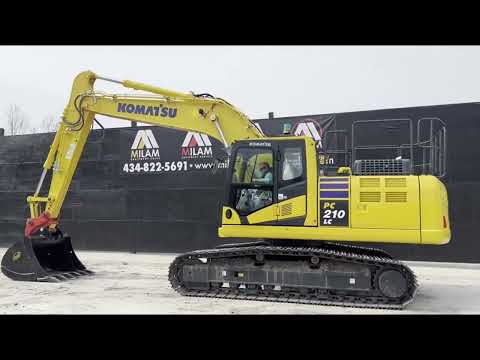
Full size excavators such as the Komatsu PC210-11 or the John Deere 350G LC bring horsepower and reach to projects requiring substantial material movement. The Komatsu PC210-11, with an operating weight near 23 tons and a robust 160-horsepower engine, handles deep trenching and large-scale foundation work with ease. Its hydraulic system supports heavy attachments, enhancing versatility.
Site managers relying on full size excavators must ensure sufficient access and ground stability, as these machines demand wider turning radii and greater clearance. The John Deere 350G LC offers impressive breakout force and bucket capacity over 1 cubic meter, significantly accelerating excavation rates. Yet, deploying such machines on constrained sites risks operational delays due to limited maneuvering room and potential safety hazards.
Matching Excavator Choice to Site Demands and Operator Expertise
Addressing the mini excavator vs full size question hinges on a detailed assessment of site conditions, project scope, and operator skill sets. For urban infill projects or utility repairs where precision and minimal site impact are paramount, mini excavators like the Cat 308 provide agility and control. Conversely, infrastructure or commercial developments with expansive footprints and heavy material loads justify full size excavators like the Komatsu PC210.
Experienced operators appreciate that mini excavators require refined control techniques to maximize their limited power and prevent equipment strain. Full size excavators, while more forgiving in force application, demand careful planning to avoid site congestion and optimize transport logistics.
Technological Advances Bridging the Gap
Recent innovations blur lines between mini and full size categories. Models such as the Volvo ECR88D offer compact frames with enhanced power packs, delivering breakout forces rivaling larger units but retaining maneuverability advantages. Similarly, full size excavators now incorporate smarter hydraulic controls and telematics, improving fuel efficiency and precision operations.
Operators can leverage these advancements to tailor machine deployment dynamically, switching between mini and full size excavators based on evolving site challenges rather than defaulting to one size. This flexibility enhances productivity while mitigating risks inherent to mis-matched equipment.