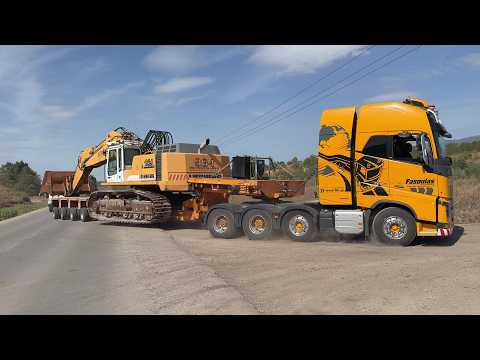
Excavator Counterweight: Solving Stability Challenges on Site
Discover how excavator counterweights tackle stability issues, featuring models like the CAT 336 and Hitachi ZX350 for safer, efficient digs.
Addressing Stability Challenges in Excavation Operations
Experienced operators know that maintaining stability during heavy digging tasks is more than a routine concern—it's a critical operational challenge. When working with long reach arms or lifting heavy loads, excavators can become unbalanced, risking tip-overs or inefficient digging. This instability compromises both safety and productivity, especially on uneven or soft ground where the forces acting on the machine shift unpredictably.
Without an effective counterbalance, the excavator's center of gravity moves forward as the boom extends or heavy materials are lifted, increasing the risk of tipping. This is particularly evident in models like the Komatsu PC200-8, where the front-heavy design demands precise counterweight calibration to handle demanding site conditions.
How Excavator Counterweights Restore Balance and Enhance Performance
Excavator counterweights are engineered specifically to address these stability issues by adding mass to the rear of the machine. This mass shifts the center of gravity backward, offsetting the forward pull of the boom and load. The result is a more stable platform that allows operators to maximize digging depth, reach, and lift capacity without compromising safety.
For instance, the CAT 336 hydraulic excavator incorporates a factory-installed counterweight system that is optimized for the machine’s specified arm and bucket configurations. This ensures that the operator can push the machine’s capabilities without risking imbalance. The counterweight not only improves stability but also reduces wear on hydraulic components by maintaining more consistent distribution of forces during operation.
Model-Specific Counterweight Strategies for Varying Site Demands
Different excavator models approach counterweight design based on their intended applications and size classes. The Hitachi ZX350, designed for medium to heavy-duty tasks, features a modular counterweight system. Operators can add or remove counterweight segments depending on the load and site conditions, offering operational flexibility. This modularity is invaluable when transitioning from trenching in tight urban environments to bulk excavation on open sites.
Meanwhile, Liebherr’s R 926 excavator employs a heavy rear counterweight as part of its base design, enabling it to handle high breakout forces without sacrificing stability. The counterweight design on this model also integrates with the machine’s undercarriage to optimize ground pressure distribution, crucial for maintaining traction on uneven terrain.
Choosing and Adjusting Counterweights to Match Operational Needs
Site managers and operators must evaluate the counterweight configuration in relation to the excavator's task profile. Over-counterweighting can lead to unnecessary fuel consumption and increased track wear, while under-counterweighting compromises safety and operational efficiency.
Adjusting counterweights on models like the Komatsu PC200-8 involves selecting from an array of optional weights that can be bolted on or removed. This adaptability helps tailor machine balance to specific tasks, such as heavy lifting versus high-speed excavation. Experienced operators often collaborate with maintenance teams to optimize counterweight setups, ensuring the excavator’s performance aligns with shifting site requirements.
Moreover, monitoring how different counterweight configurations impact machine dynamics is essential. Advanced models now incorporate onboard sensors that provide real-time feedback on stability metrics, allowing operators to adjust their approach dynamically.
Conclusion: Leveraging Counterweights for Safer, More Efficient Excavation
Stability remains a persistent challenge in excavation, especially as projects demand greater reach and heavier material handling. Excavator counterweights are a critical solution, restoring balance and enabling machines like the CAT 336, Hitachi ZX350, Komatsu PC200-8, and Liebherr R 926 to operate safely and efficiently under diverse site conditions. Understanding the role and proper management of counterweights empowers operators and site managers to push performance boundaries without compromising on safety.