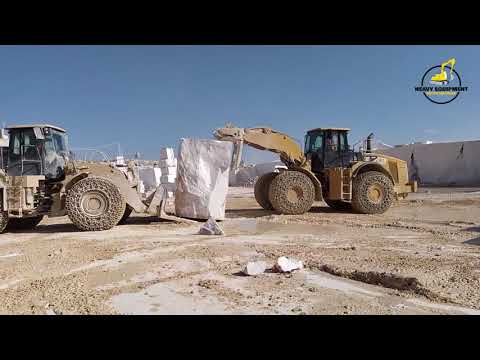
Komatsu WA500 vs Cat 950: Detailed Wheel Loader Specs Comparison
Compare the Komatsu WA500 and Cat 950 wheel loaders through key specs and job site impact for experienced operators and site managers.
Engine Power and Performance Metrics
The Komatsu WA500-8 features a 242 kW (324 hp) engine, while the Caterpillar 950 GC offers 180 kW (241 hp) in its base model and up to 241 kW (323 hp) in the 950M variant. On paper, this places the WA500-8 and 950M on nearly equal footing in raw horsepower, but the WA500-8's Komatsu SAA6D140E-7 engine is known for its torque curve optimization, which translates to more consistent power delivery during heavy lifts and sustained loading cycles.
On tough job sites moving dense materials like gravel or clay, the WA500’s torque ensures less bogging down when handling heavy buckets, whereas the 950 GC’s engine is tuned for fuel efficiency. The 950M balances power and fuel economy better than the GC, making it a competitor closer to the WA500-8.
Operating Weight and Stability Implications
The operating weight of the WA500-8 is approximately 25,800 kg (56,880 lbs), whereas the 950 GC weighs in around 22,000 kg (48,500 lbs), and the 950M at about 24,500 kg (54,000 lbs). This weight difference affects stability and breakout forces directly.
Heavier loaders like the WA500-8 provide enhanced stability when carrying maximum payloads, especially when working at height or on uneven terrain. This translates to safer and more efficient load cycles during tasks like stockpile loading or truck loading, where machine stability reduces operator fatigue and cycle time.
Bucket Capacity and Payload Optimization
The WA500-8 usually comes with a 5.0 to 5.5 m³ bucket, while the Cat 950 GC is equipped with a 3.0 to 4.5 m³ bucket, and the 950M ranges up to 5.2 m³. Bucket size directly affects the volume of material moved per cycle; larger buckets on the WA500 and 950M support higher production rates when handling bulk materials.
However, bucket capacity alone doesn’t determine efficiency; it must be matched with breakout force and lift capacity. The WA500-8 delivers higher breakout forces—up to 290 kN—compared to 228 kN on the 950 GC and roughly 270 kN on the 950M. This means the WA500 can handle frozen or compacted materials more effectively, reducing cycle times in challenging conditions.
Hydraulic System and Lift Speeds
Hydraulic responsiveness and lift speeds critically affect cycle times on site. The WA500-8 uses a load-sensing hydraulic system that adjusts flow automatically, improving fuel efficiency and providing smoother operation. Its lift arm can reach maximum height in about 7.5 seconds.
The 950M employs an electro-hydraulic system with variable flow pumps, enabling rapid bucket and lift arm movements. Its lift speed is competitive, often clocked under 7 seconds to full height. The 950 GC, with a simpler hydraulic system, shows slower lift cycles, typically around 8 seconds.
Faster lift cycles translate to more loads per hour, especially important in high-throughput operations. Operators report that the 950M feels more agile during tight truck loading, while the WA500’s hydraulic system offers better control under heavy loads.
Fuel Efficiency and Operating Costs
Fuel consumption differences emerge primarily from engine tuning and hydraulic system design. The WA500-8’s electronically controlled engine optimizes fuel burn without compromising power, averaging around 20% better fuel economy compared to older WA470 models. The Cat 950 GC is designed as a more cost-conscious option with lower initial cost and fuel consumption, but it sacrifices some power and speed.
The 950M attempts to blend performance and economy with features like auto idle and advanced engine controls, resulting in fuel savings of approximately 10% compared to the GC model. For operators managing fleet fuel costs, these differences can accumulate significantly over a full project.
Ergonomics and Operator Visibility
Experienced operators value cab design for long shifts. The WA500-8 features a spacious operator station with low noise levels, adjustable seats, and excellent all-around visibility due to its elevated cab position and optimized window layout. The multi-function joystick integrates drive and loader controls, reducing fatigue.
The Cat 950 GC and 950M cabs focus on simplicity and comfort, with the 950M featuring an improved HVAC system and touchscreen interface for machine parameters. Visibility is marginally better on the 950M due to redesigned rear view mirrors and rear camera options, aiding maneuvering in congested sites.
Summary of Job Site Impact
Choosing between the Komatsu WA500 and Cat 950 models hinges on matching machine specs to site priorities. The WA500-8 excels in high breakout force and consistent torque, making it better suited for dense or frozen materials and demanding loading cycles. Its larger operating weight and bucket capacity support heavy-duty productivity but come with a higher initial investment.
The Cat 950 GC offers a lighter, more economical profile, ideal for general construction and earthmoving where fuel economy and upfront cost are critical. The 950M closes the gap with power and hydraulic responsiveness closer to the WA500, offering a balanced approach for operators who need agility and efficiency.
For site managers and operators, integrating these spec nuances into fleet deployment plans can optimize productivity and reduce operational costs on complex projects. It’s not just about raw numbers but understanding how those translate into daily cycle times, fuel budgets, and machine durability under load.