
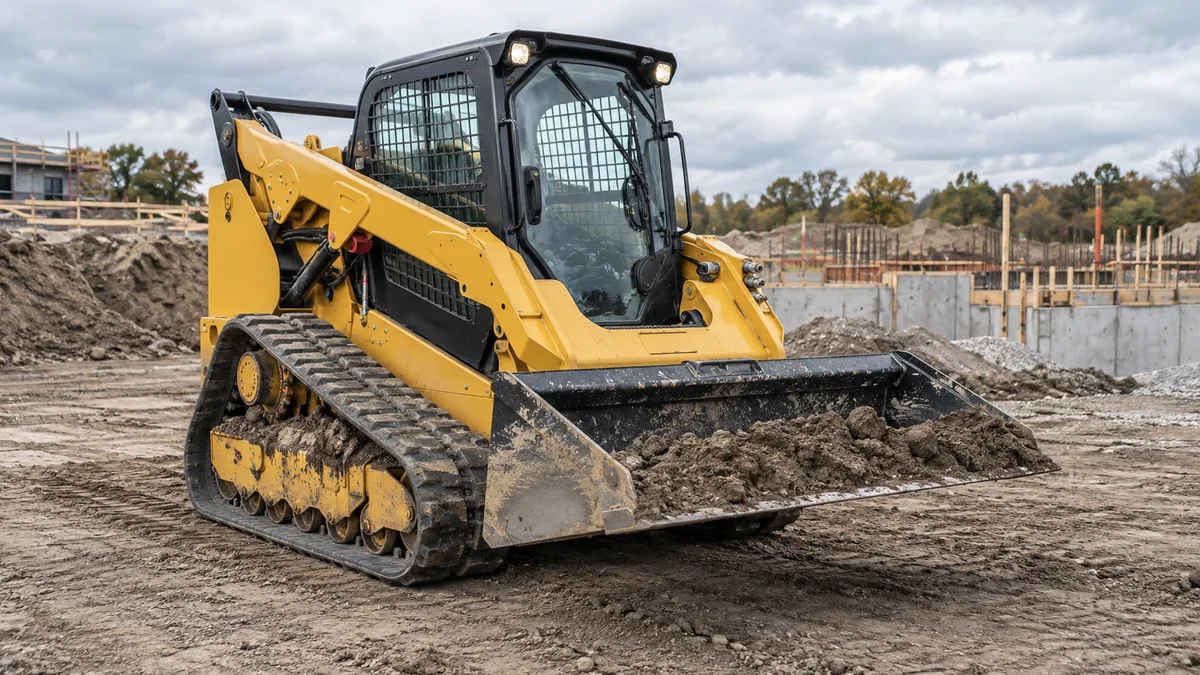
Standard flow vs high flow: start with the attachment's operating window
A high-flow label does not by itself make an attachment compatible with a skid steer or compact track loader. Compare the attachment's permitted flow and working-pressure range with the machine's installed package, then check return plumbing, case drain, controls, cooling and the approved carrier match. A physical coupler fit is only one part of that decision.
Standard-flow attachments can sometimes be used on a high-flow-equipped loader at the correct standard setting. A tool requiring high flow needs a carrier equipped and approved to provide it. Do not assume that every breaker, mower or auger uses the same hydraulic specification; the exact attachment model matters.
Use a six-part compatibility record
| Item | Attachment information to obtain | Carrier information to verify |
|---|---|---|
| Flow | Minimum, preferred and maximum flow | Available auxiliary flow and approved selectable setting |
| Pressure | Required working range and maximum permitted pressure | Package and coupler pressure specification |
| Return and case drain | Backpressure limit and required connections | Correct approved return and drain arrangement |
| Controls | Harness, connector and control functions | Installed control kit and software support where required |
| Mechanical fit | Mount, tool weight and working width | Approved attachment interface and capacity |
| Application approval | Guarding, operating restrictions and duty requirements | Manufacturer-approved carrier-and-tool combination |
Download the attachment matching worksheet (CSV) to collect this information for dealer quotations. An empty field is a question to resolve, not a default approval.
Why gallons per minute do not tell the whole story
For US units, ideal hydraulic power is approximately flow in US gpm × pressure in psi ÷ 1,714. This describes fluid power at the stated operating point. Engine input and useful mechanical output also involve losses; the result is not guaranteed attachment shaft horsepower.
| Illustrative operating point | Calculation | Ideal fluid power |
|---|---|---|
| 20 gpm at 3,000 psi | 20 × 3,000 ÷ 1,714 | 35.0 hp |
| 30 gpm at 3,000 psi | 30 × 3,000 ÷ 1,714 | 52.5 hp |
| 30 gpm at 3,500 psi | 30 × 3,500 ÷ 1,714 | 61.3 hp |
These points are arithmetic examples, not specifications for a named loader. Maximum advertised flow and relief pressure may not be simultaneously available during continuous work. Use the carrier and attachment documentation rather than multiplying two brochure maxima and treating the answer as a tested production figure.
A worked attachment-window example
Suppose an attachment document requires 24–30 gpm, with its pressure, plumbing and approved-carrier conditions also specified. A loader supplying 20 gpm is below the listed flow window. A loader advertised at 35 gpm is not automatically acceptable either: it would need an approved setting within the attachment's range. A documented 27 gpm setting clears only the flow check; every other compatibility item still needs verification.
The same reasoning applies when comparing Kubota SVL75-3 and Bobcat T76-2 or Cat 299D3 and Deere 333 P-Tier. A larger number is useful when the intended attachment needs it and the complete match is approved.
Case drain and return connections are not interchangeable
If an attachment requires a case drain, obtain the prescribed connection arrangement and backpressure limit from its manual. Do not assume a spare hose can be connected to any available port. A missing requirement on a seller's listing is a reason to request documentation, not evidence that the tool has no requirement.
Before attachment work, follow the machine's shutdown, pressure-release and connection procedure. Hydraulic injection injuries are serious; do not search for a pressurized leak with a hand. Pressure measurements and circuit changes belong with trained personnel using the correct equipment and service instructions.
When paying for high flow can make sense
List the actual powered attachments you expect to use and the paid work each one enables. A high-flow option has little production value if the recurring work uses approved standard-flow tools or non-powered buckets and forks. It can matter when an approved planer, cutter or other demanding attachment needs the extra capability.
Use a simple business worksheet: additional machine/package cost, attachment cost, expected chargeable hours and observed output in a comparable demonstration. Keep fuel, wear parts, tool maintenance and transport separate. The package name is a specification; the business case is how the approved combination performs on your work.
Questions to settle before a rental or purchase
- Is the hydraulic option installed on this exact machine?
- What flow setting is approved for the exact attachment?
- Are the hoses, couplers, drain and electrical controls correct?
- What guarding and operator protection does the application require?
- Will the dealer put the approved combination on the quote?
For a worked milling-width decision, continue to the cold planer attachment guide.
Sources and arithmetic basis
- Bobcat hydraulic flow options.
- Bobcat attachment compatibility guidance.
- Parker hydraulic power and unit-conversion equations.
References were checked on October 28, 2026. Power examples are Heavy Equipment Hub calculations with no efficiency allowance.


